Decode HL7 v2 messages without sending them anywhere
PipeHat parses, decodes and validates HL7® v2 messages right in your browser. Every field named, every code explained, every message checked against the version it claims and every version from 2.1 to 2.8.2. Patient data never leaves your computer.
- 1
PID-3.1ID NumberMRN100234 - 2
PID-3.4Assigning AuthorityMERCY - 3
PID-3.5Identifier Type CodeMR = Medical record number · table 0203 - 4
PID-5Patient NameFamily SAMPLE, given JANE, middle Q - 5
PID-7Date/Time of BirthNot a valid HL7 date; expected YYYYMMDD (19800101) - 6
PID-8Administrative SexF = Female · table 0001

Parse, decode, validate
Paste messages, open a file or drop it on the page. One message or a feed log with hundreds of thousands.
- 1Parse
Splits the raw text at its separators (
|^~&) into segments, fields, components and repeats. MLLP framing and batch headers are handled. - 2Decode
Names every piece for the message's version and explains it: PV1-2 is Patient Class, table 0004, and
Imeans Inpatient. Escape sequences are resolved. - 3Validate
Checks required fields, formats, codes, message structure and ICD-10, and which version from 2.1 to 2.8.2 the content actually fits.
Find out which version a message really is
Senders often say one version in MSH-12 and send another. PipeHat checks every message against all 12 versions from 2.1 to 2.8.2 and shows which one the content fits, down to the field that gives it away.
How version fit works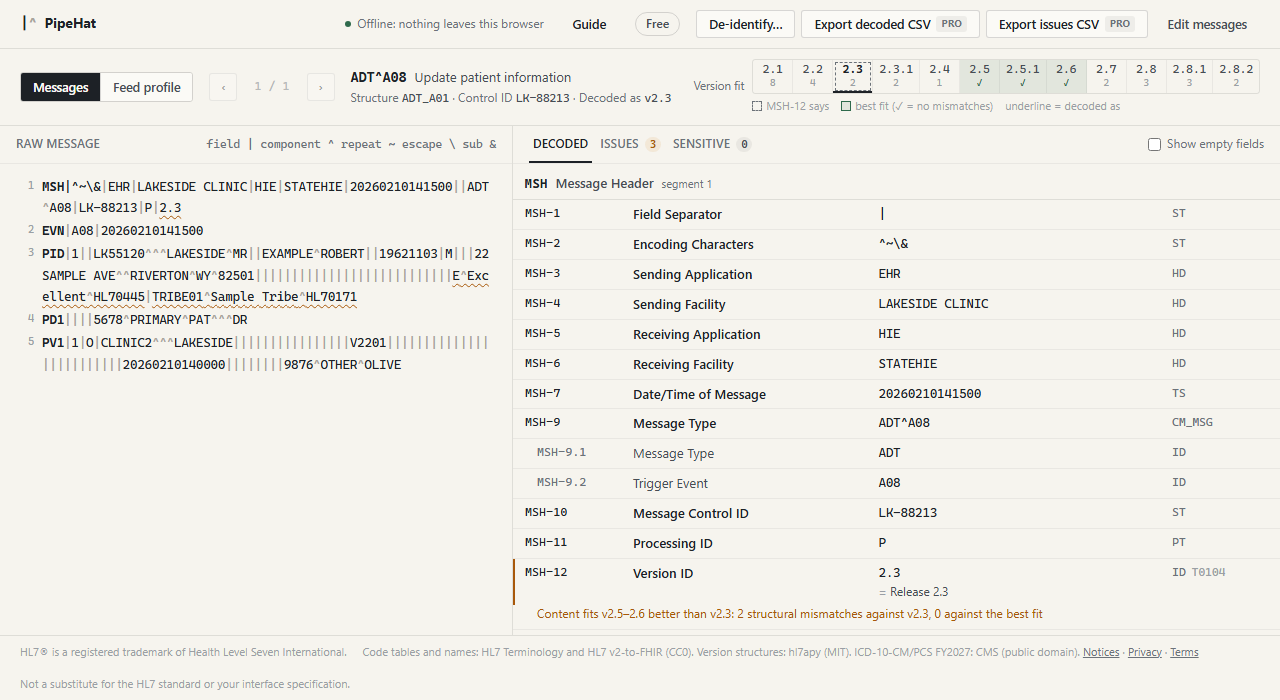
Catch problems before they reach your database
- Required fields left empty, invalid dates and numbers, extra repeats and components
- Codes missing from HL7 tables, deprecated codes, segments that don't belong
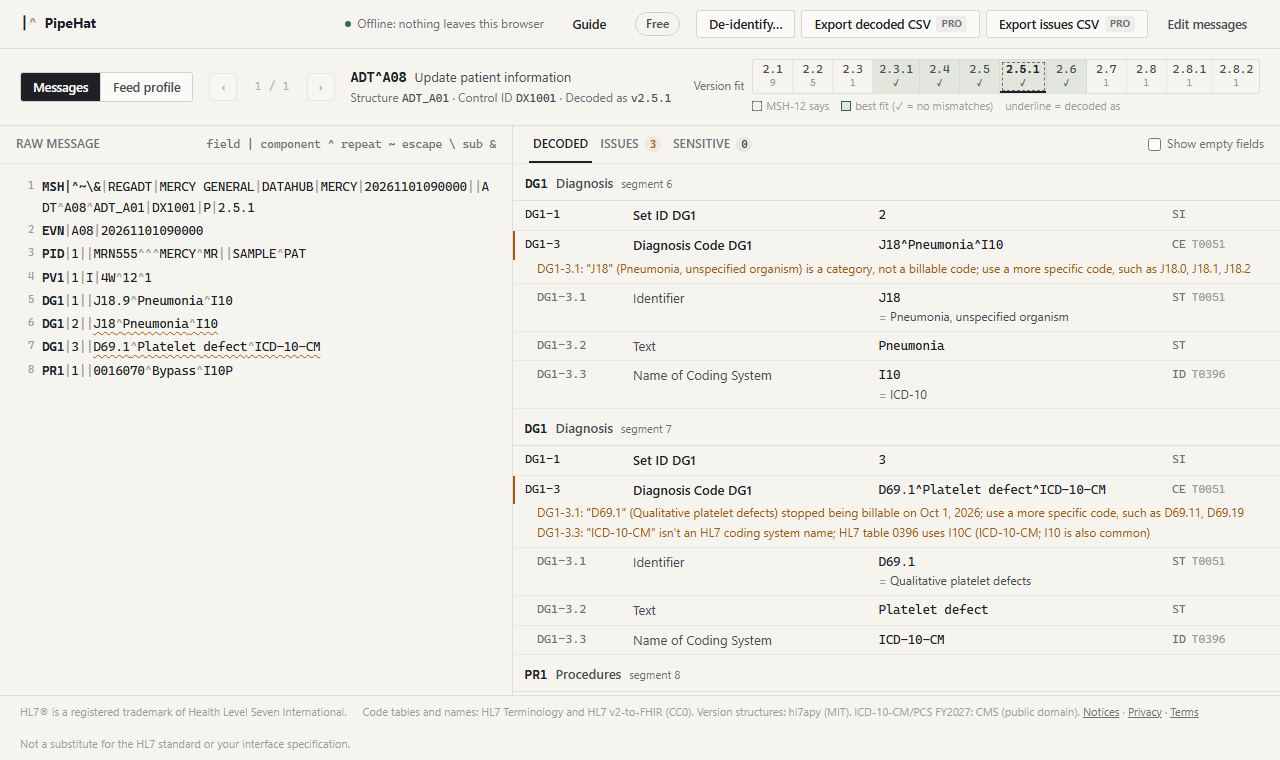
- The full ICD-10-CM and ICD-10-PCS code sets (FY2027): invalid, deleted and non-billable codes, with billable alternatives
Built for real feeds Pro and up
Open a whole day of messages. Big files are read in batches of 10,000, the first message shows instantly, and every batch is checked in the background. Export decoded values and issues to Excel in one file.
Large files and exports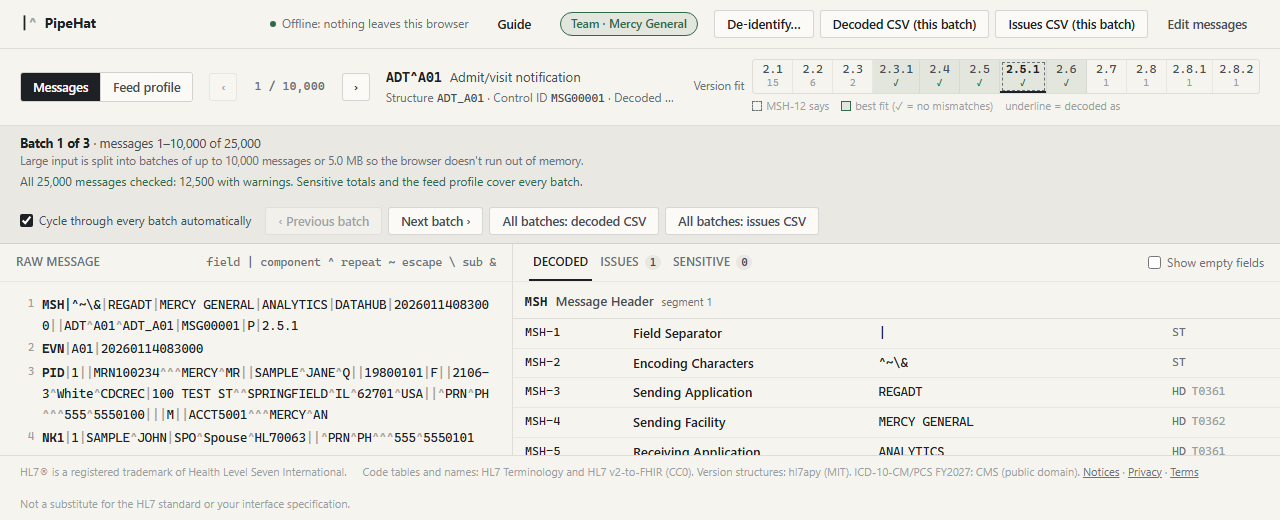
See what a partner actually sends Team and Business
The feed profile shows every field across every message: how often it's filled, distinct and top values, lengths, date ranges, problems, and fill rates by event type. Identifying values are hidden, so a profile is safe to share.
Feed profile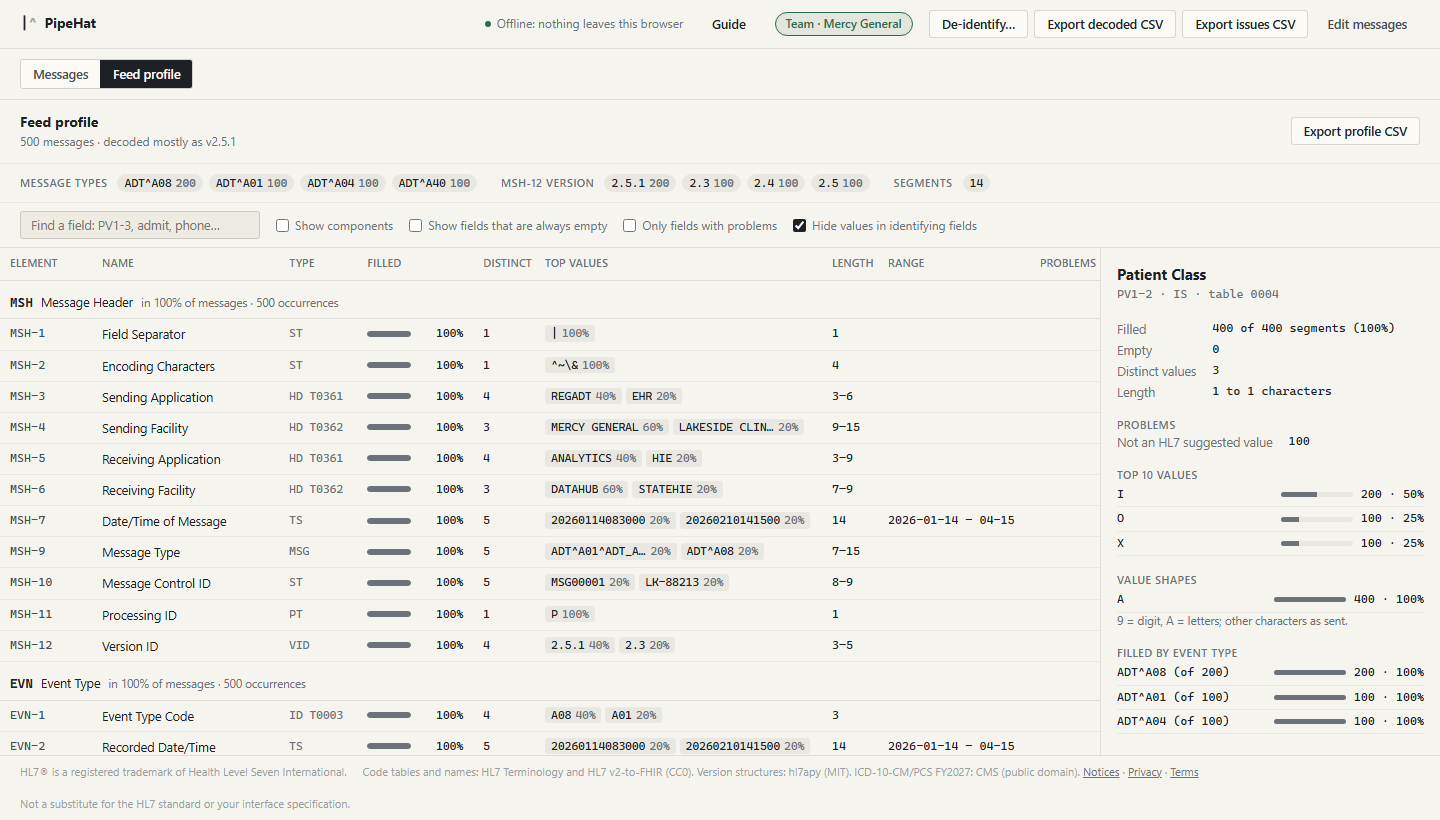
Flag HIV, substance use and other protected data Business
Find values that need special handling before data moves downstream: HIV, substance use disorder (42 CFR Part 2), mental health, sexually transmitted infections, reproductive health, genetics, abuse and gender identity. It checks diagnosis codes and free-text phrases, and rolls findings up by patient.
Sensitive information check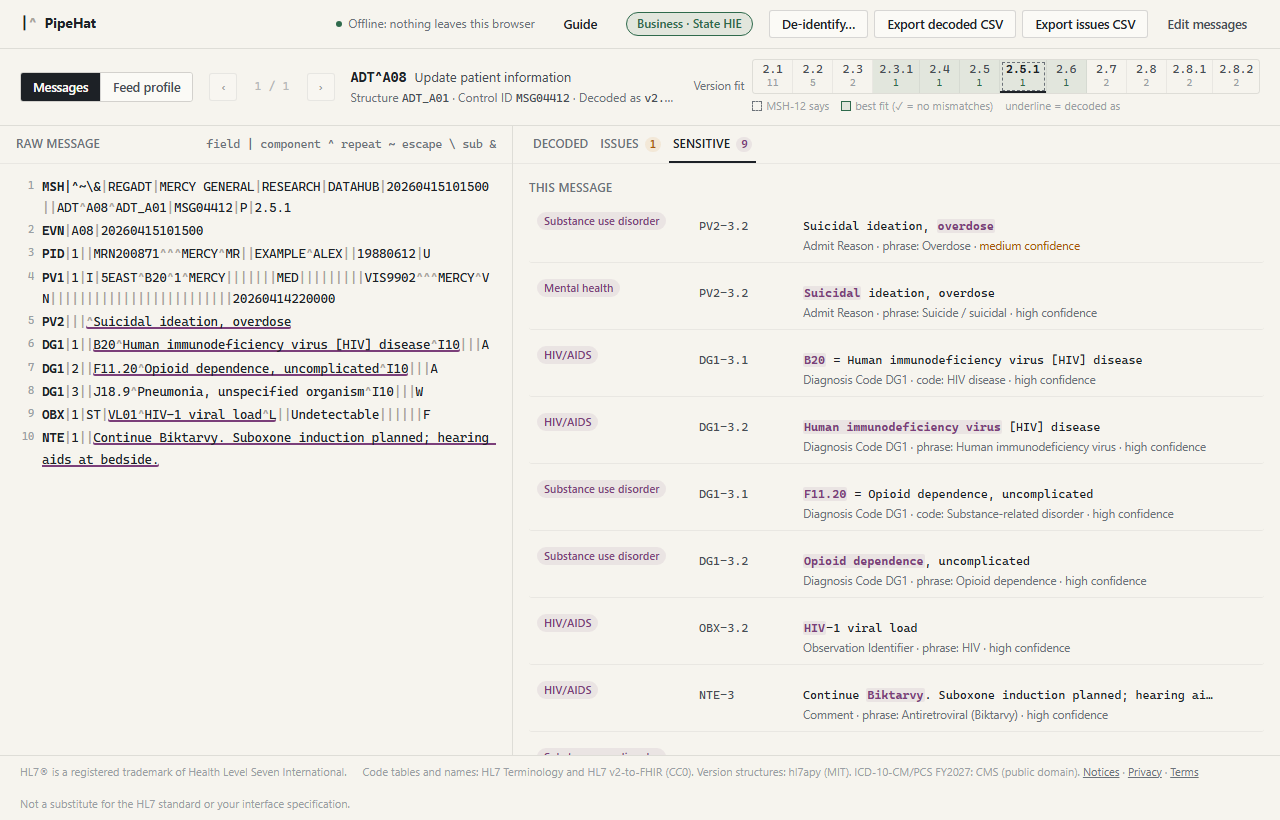
Share messages safely All plans
The de-identifier replaces names, identifiers, addresses, phone numbers and dates, consistently within a run, so the message still decodes and tests like the original. A leftover check tells you if anything replaced still appears.
De-identifier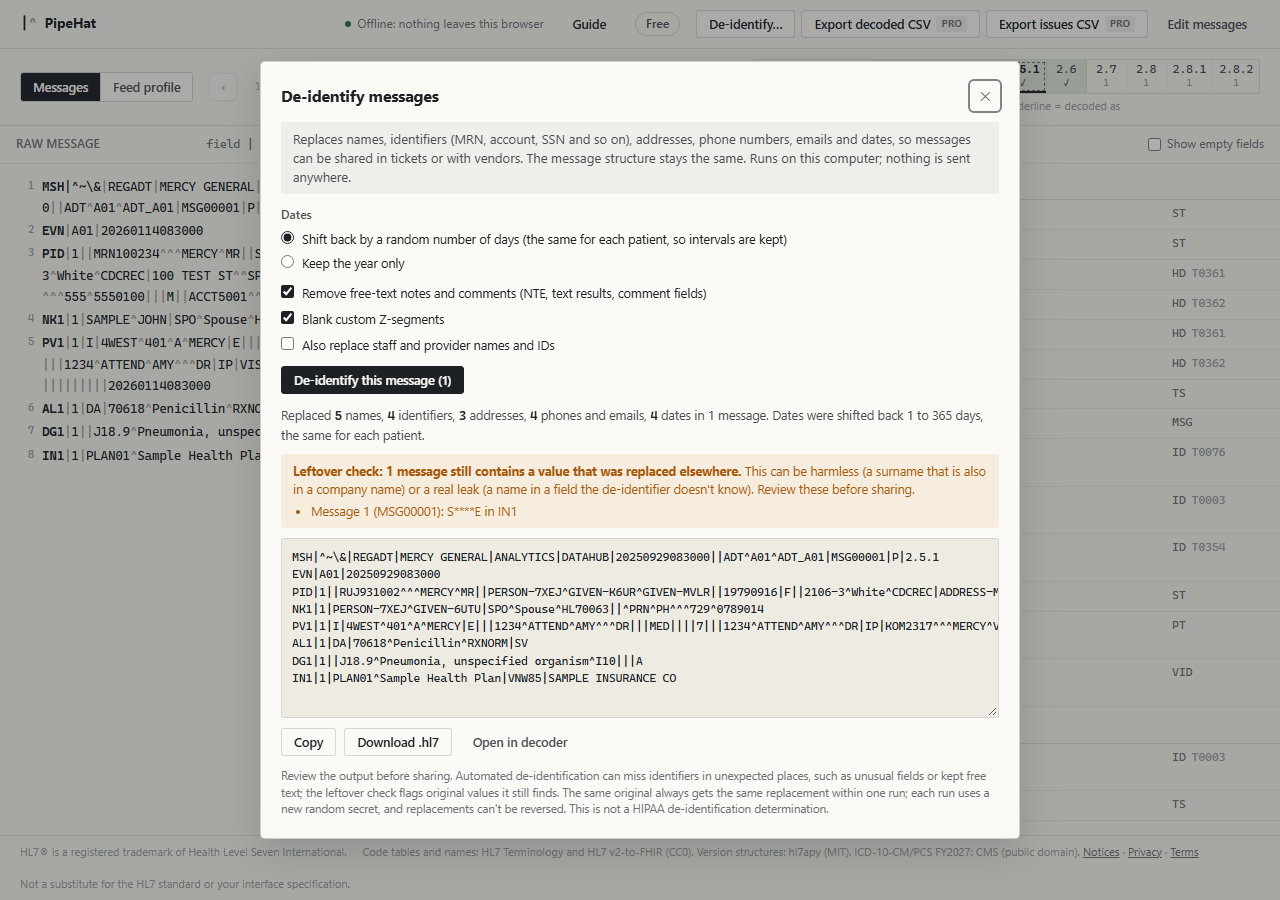
Your messages never leave your computer
HL7 messages are full of patient information. PipeHat is built so that we never see them.
No uploads
The page blocks every kind of network request. Open your browser's developer tools and watch the Network tab while you decode: nothing goes out.
Nothing stored
No sign-up and no tracking. Messages live only in the open tab and are gone when you close it.
Licenses checked locally
License keys are verified on your computer with a digital signature. Nothing phones home, so it works on locked-down networks.
Simple yearly plans
Priced by team size, not by message volume: decode as much as you like.
- First 10 messages of any input
- All checks, ICD-10, version fit
- De-identify one message at a time
- Everything in Team
- Sensitive information check
- Priority support
Questions
Are my messages uploaded anywhere?
No. PipeHat runs entirely in your browser, and the page itself blocks network requests, so it can't send your messages anywhere. They're never saved either: close the tab and they're gone. Only your license key and two settings are kept in your browser.
Which HL7 versions does it support?
HL7 v2.1 through 2.8.2: 12 versions, including 2.3.1, 2.5.1 and 2.8.1. Messages are decoded against the version in MSH-12 and checked against all the others. Messages that claim a later version are decoded as 2.8.2, with a note.
Which message types?
Any HL7 v2 message: ADT, ORU, ORM, SIU, MDM, DFT, VXU and the rest. Every message structure in the standard is checked, including which segments belong and which are required.
Do I need to install anything?
No. It runs in current versions of Chrome, Edge, Firefox and Safari. Once the page has loaded, it doesn't need a connection.
What is HL7 v2?
HL7 version 2 is the messaging standard most hospital systems use to exchange admissions, lab results, orders and billing. Messages are lines of text with fields separated by | and components by ^, so their meaning depends entirely on position. PipeHat tells you what each position means.
How do licenses work?
After you buy, we email you a license key. Paste it into PipeHat once and it's saved in your browser; each person on your team does the same. Licenses last a year. See pricing for details.
Paste a message and see for yourself
Free, with nothing to install and nothing uploaded.